The Solomonic Design Principle: How to Filter for Desired Outcomes Automatically
From the wisdom of Prophet Solomon to the FillToHere line at Emery Worldwide to Van Halen's M&Ms: three stories that explain a single design principle that filters for desired outcomes with elegance.
This post is a translation of the original Arabic article.
It is narrated in a hadith from the Prophet, peace be upon him:
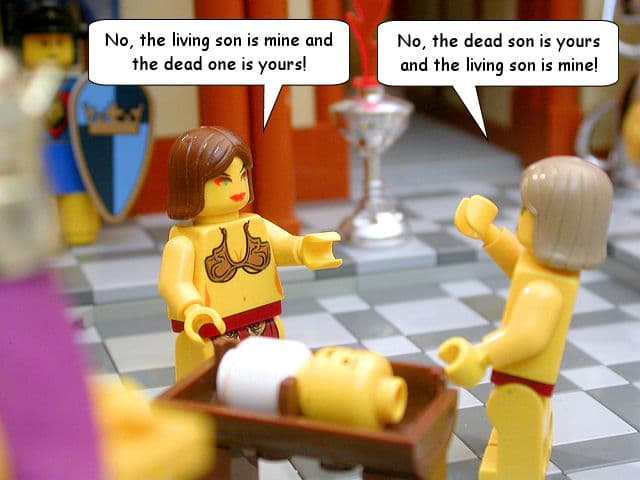
Two women each had a child with her. A wolf came and carried off one of the children. Each woman claimed the wolf had taken the other's child. They brought their dispute to David, who ruled in favor of the older woman. As they left, they passed by Solomon, son of David, and told him what happened. He said: "Bring me a knife so I can divide the child between them." The younger woman cried out: "Do not do it, may God have mercy on you — it is her child!" So he ruled in favor of the younger woman.
If you love engineering and design, you almost certainly love solving problems. An engineer's life and joy lies in problem-solving, and every engineer — according to their specialty — tries to solve problems in their own way. The mechanical engineer builds a machine; the software engineer writes an application that solves the very same problem in a completely different way. Yet what most engineers agree on are the fundamentals and principles of design: the ground rules on which problems are solved.
Today I will discuss one of these design principles: embedding elements within a design to reduce errors and automatically filter out undesirable outcomes.
In the story of Prophet Solomon, there were no DNA tests or anything similar available in those days. He had to design a solution that would eliminate the lie. The design may seem illogical or cruel by some standards, but behind it lies profound wisdom — it was built on the premise that a mother will never accept harm coming to her child no matter what (human nature). So he made human nature and the instinctive response the filtering element.
The FillToHere Story, Emery Worldwide
Another form of this design appears in a problem that cost air freight companies enormous sums of money, particularly Emery Worldwide Freight, now owned by UPS.
The problem was loading containers with varying quantities of identically sized boxes. Every empty space cost the company many dollars. Numerous consulting firms were invited to propose technical solutions: sensors, lasers, counting devices, mobile apps, cameras, weight calculations. Every proposal was either too expensive to implement, impractical, or both.
Then one creative thinker, Ed Feeney, proposed a simple idea: draw a line near the top of each container and write on it "Please fill the container to here!!" As simple as it was, and as easy to implement, it turned out to be the cheapest and most effective solution of all. Workers fill each container until they reach the line, ensuring every container holds the same number of boxes every time.

The M&Ms Story, Van Halen
In the book "Think Like a Freak" by the Freakonomics team, they discuss the principle of "how to make a garden clean itself" through the very same design principle we are exploring here. They tell a wonderful story about a famous rock band from the 1970s called Van Halen and their lead singer David Lee Roth.
The band was touring the United States performing concerts. The press leaked what became one of the most famous celebrity demands in history: David Lee Roth required that the venue provide a full bowl of M&Ms with all the brown ones removed, leaving only the yellow ones.

Years later, in an interview, David Lee Roth explained why he insisted on the M&Ms. He said: when they were performing concerts in the 1970s, massive crowds of fans would gather. They imposed many detailed requirements on promoters regarding stage setup and crowd safety. The M&Ms were simply the easiest way to tell whether the promoter had read the contract carefully.
All you had to do was glance at the M&Ms bowl. If there were any brown ones, it was time to conduct a thorough inspection of the venue to verify all the details had been attended to.
The Takeaway
All three examples demonstrate the power of this design in solving problems. It is clean in principle — it filters for the desired outcomes quickly and without requiring active thought from anyone. It is the brilliance of the Solomonic wisdom that our Prophet, peace be upon him, taught us through the story of the wisest of engineers.
If you enjoyed today's post, I invite you to share in the comments any stories or solutions you have designed in the Solomonic style.