If Everyone Has AI, Who Has the Advantage?
Rock Health stopped tracking AI-enabled health companies as a separate category in Q1 2026. The competition has shifted to who owns the workflow, the data, the integration, and the outcome.
This post is a translation of the original Arabic article.
Two years ago, the phrase "powered by AI" was enough to open a conversation with an investor, attract a client, or give a product a distinctive presence. Today it has become an expected checkbox in almost every technology pitch.
AI has entered clinical documentation, scheduling, insurance approvals, claims processing, medical imaging analysis, patient communication, and clinical decision support. Every company can access powerful models and build a decent experience on top of them in less time and at lower cost.
That proliferation has shifted the investment question quickly. In its Q1 2026 report, Rock Health announced it would stop tracking AI-enabled digital health companies as a separate cohort. The technology has become part of the operating environment all digital health companies work inside.
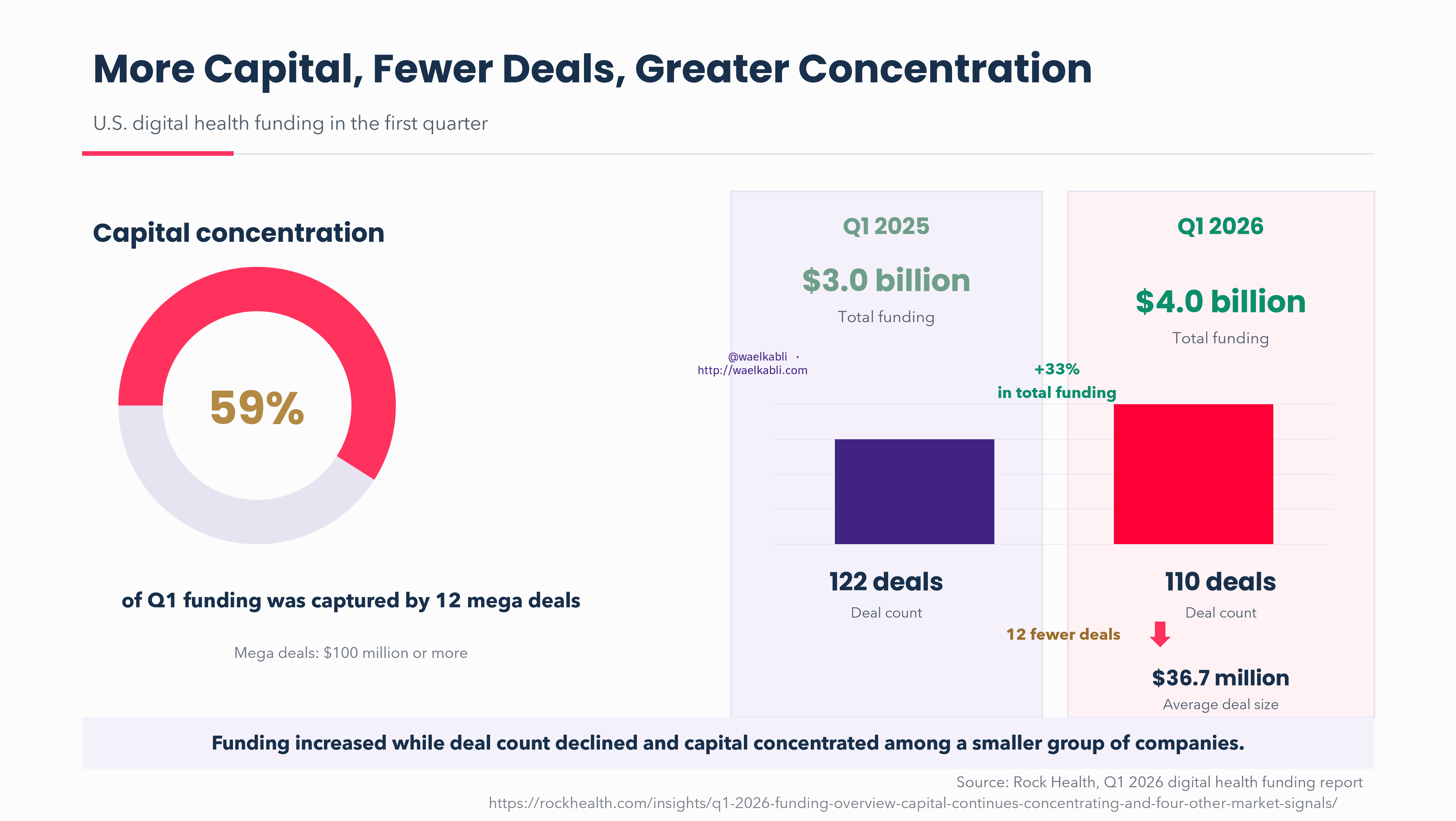
In that same quarter, U.S. digital health funding reached $4 billion across 110 deals, with 12 mega-rounds capturing 59% of all capital. The market is sending a clear signal: the availability of AI has expanded the capacity to build, and it has raised the value of the assets that surround it.
Value Begins After the Answer
Large language models can read a medical report, summarize a visit, draft a letter, suggest an initial code, and answer a patient question. These are meaningful capabilities that can save hours of work.
But economic value in healthcare appears when the task is complete.
Take a prior authorization as an example. A model can draft the submission in seconds. What follows is an entire chain of work: gathering missing data, verifying coverage eligibility, matching diagnosis to procedure, submitting the request, tracking the response, handling the exception, coordinating with the physician and patient, and recording the decision inside the system.
This is where the distinction becomes clear between a tool that completes one step and a product that owns the responsibility for moving a case from request to resolution. The latter has become part of how healthcare facilities operate.
Building Cura and working in digital health taught me that the hardest moment usually comes between systems, organizations, and roles. The technology does its part, then the transaction stalls because of a missing piece of information, an access permission, an approval, a clinical exception, or a decision that requires a human. That is where a product accumulates expertise, and that is where a company's value emerges.
This is why the success of health AI is tied to four practical conditions:
- It enters the daily workflow of the physician, the administrator, and the patient
- It connects to the systems that carry data and decisions
- It handles both routine cases and exceptions
- Its impact is measured after implementation by time, cost, quality, and health outcome
| Dimension | An AI-powered feature | A product that owns the workflow | |---|---|---| | What it delivers | An answer, summary, recommendation, or draft | A completed transaction from request to outcome | | Position in operations | A standalone step the employee uses when needed | A continuous part of how the facility runs | | Integration | Manual data transfer between the tool and other systems | Direct connection to the medical record, insurance, lab, and pharmacy | | Exceptions | Passes the case back to the user | Detects the exception, routes it to the right person, and tracks resolution | | Accountability | Quality of the output the model generated | Quality of execution, decision, and outcome | | Measurement | Accuracy, speed, and usage count | Time, cost, productivity, quality, and health outcome | | Economic value | Limited savings on a specific task | Recurring impact tied to a budget, a contract, and continuity |
The Advantage Is Built Around the Model
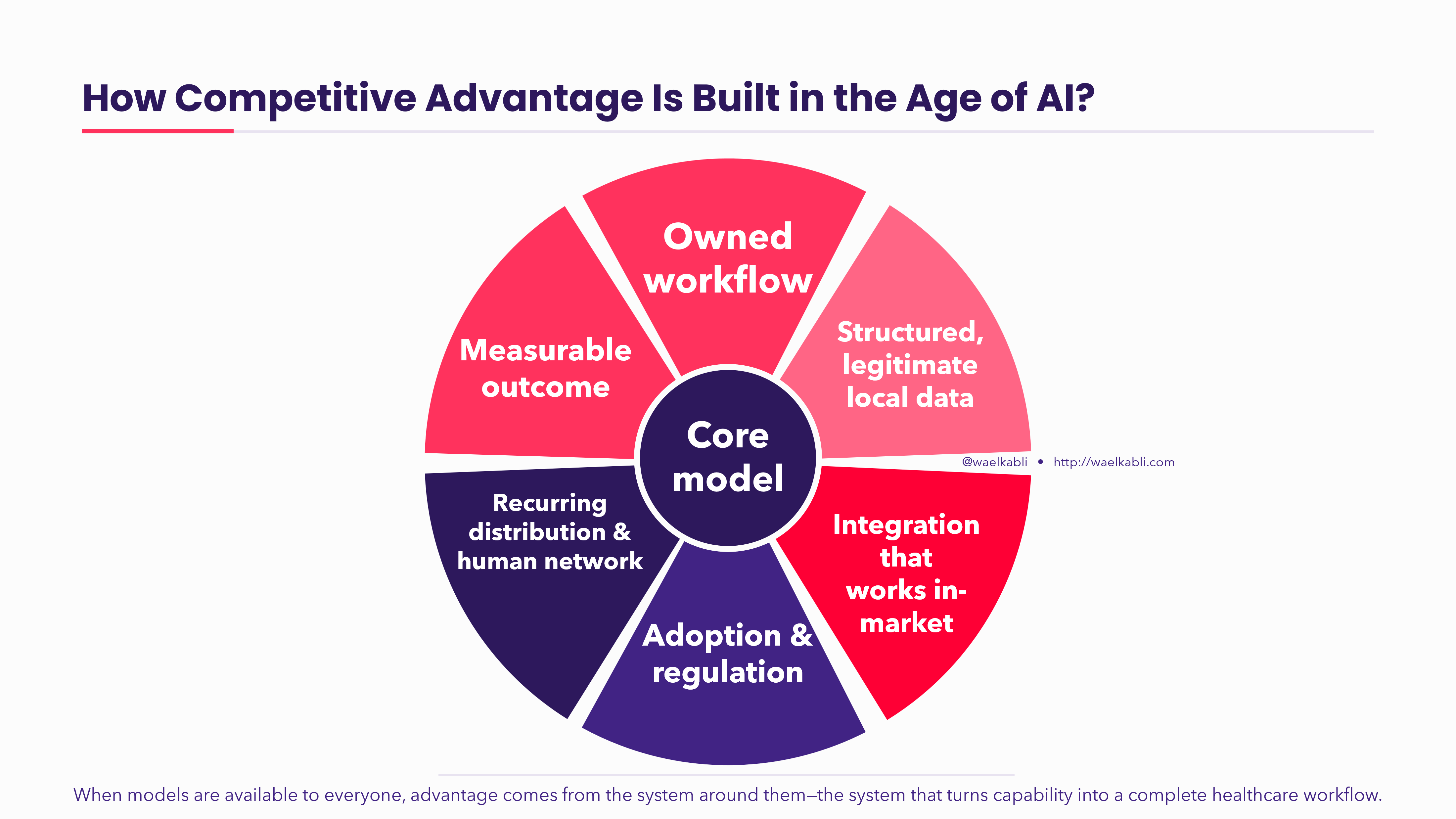
Foundation models evolve quickly, the cost of using them falls, and the differences between them shift with every release. Value therefore accumulates in layers that are more stable and closer to operational reality.
1. Owning an Important Workflow
A product's value rises when it becomes part of a clear daily process: a patient referral, a prescription dispensing, an insurance claim, a chronic disease follow-up. The FHIR standard itself illustrates that healthcare workflows encompass requests, care plans, referrals, results, payments, and the relationships between these steps. Understanding the full process gives a company knowledge that cannot be compressed into a clean interface.
2. Local, Structured, and Legitimate Data
Health data derives its value from quality, context, and the company's right to process and use it. In Saudi Arabia, the Personal Data Protection Law establishes the baseline for handling individual data, while health regulators set additional standards for exchange and use.
Every legitimate transaction can improve the underlying models, surface exceptions, and raise decision quality. That feedback loop becomes a compounding asset when it combines legality, structure, and data quality.
3. Integration That Works Inside the Market
A health product lives inside hospital systems, insurance companies, laboratories, pharmacies, and patient records. The National Health Information Center has published Saudi interoperability specifications to standardize the exchange of patient, provider, order, and results data. The NPHIES platform consolidates aspects of health and insurance information exchange and coding.
Successful integration combines technology with an understanding of responsibilities, access rights, and decision sequences. With every real connection, a company learns how the sector actually works.
4. Regulatory Standing Proportional to Product Impact
Regulatory responsibility shifts with what a system actually does. A tool that summarizes a meeting is different from software that analyzes medical data to suggest a clinical decision. The Saudi Food and Drug Authority has clarified that software fulfilling a medical purpose—such as diagnosis, treatment recommendation, or clinical decision support—falls under medical device regulation and requires marketing authorization.
The Good Machine Learning Practice principles for medical devices tie product quality to the full product lifecycle: data design, testing, human-AI team performance, and post-deployment monitoring.
A company that builds evidence and governance from the start compresses time to scale and raises the confidence of facilities, physicians, and regulators.
5. Recurring Distribution and a Human Network
Ongoing access to physicians, patients, or payers gives a company a live context for product use. The human network remains a fundamental part of the service: a physician reviewing a sensitive case, a specialist resolving an exception, a quality team monitoring performance, an accountable decision-maker. That network converts AI from a general capability into a service that can be trusted.
6. A Measurable Outcome
Value appears in a number the customer understands: shorter time to authorization approval, fewer claims errors, faster access to treatment, improved physician productivity, or better clinical outcomes.
The closer the measurement gets to the outcome, the stronger the connection between the product and a real budget. This is where AI moves from a technology line item to an economic asset inside a healthcare facility.
Arabic as a Clinical Layer in the Product
Building an Arabic health product means incorporating language, terminology, context, and ways of working. A patient describes their condition in their dialect. A physician writes in a mix of Arabic, English, and abbreviations. A decision depends on locally available medications, national protocols, and coverage, coding, and regulatory policies.
Recent research makes this concrete. A 2026 study published in ACL Anthology proceedings found a persistent performance gap between models on Arabic and English medical tasks, with the gap widening as task complexity increased. It also found weak correlation between a model's expressed confidence and the accuracy of its answer. The MedArabiQ project introduced a benchmark covering seven Arabic medical tasks, confirming the field's need for high-quality data and evaluations that span language and medical context.
This makes Arabic-language testing part of product architecture. Performance must be measured by dialect, age, gender, region, specialty, task type, and risk level. Edge cases where the model hesitates, cases requiring human escalation, and decision documentation all need systematic testing.
A Saudi company starting from a complete local workflow builds knowledge that goes beyond translation. It accumulates terminology, protocols, integrations, regulatory standing, and user behavior in a single asset that develops with use.
What Aidoc Tells Us
Case study: Aidoc
Funding: The company raised $150 million in a Series E round in April 2026, bringing total disclosed funding above $500 million.
Deployment: Its technology operates in approximately 2,000 hospitals.
What it built: A clinical model, an enterprise platform, integration inside radiology workflows, regulatory clearances, and AI governance mechanisms at the facility level.
Investment implication: Capital went to a system that entered the hospital, earned the confidence of regulators, connected to the physician's work, and became capable of expanding across multiple use cases. The model is a powerful element inside that system, and its value multiplies from what was built around it.
Source: Aidoc — Series E announcement
Questions That Reveal Investment Quality
When evaluating a health company using AI, a rigorous read starts with the work the company actually completes:
- What task finishes from beginning to end?
- Who uses the product, who pays, and who carries the decision?
- Which systems does the product actually operate inside?
- How are exceptions managed, and what fraction escalates to a human?
- Where does the data come from, and what are the company's rights to process and learn from it?
- How does performance vary across demographic groups, languages, and dialects?
- What is the cost per completed transaction at scale?
- What operational, financial, or clinical outcome improved?
- What assets remain with the company when the underlying model is replaced?
These questions reveal product depth more accurately than transaction volume or model size. They distinguish a company that built a fast capability from one building a position that is hard to displace inside the health system.
Who Has the Advantage?
AI today accelerates the pace of building and reduces the cost of experimentation. That is a meaningful development for founders and for healthcare as a sector. At the same time, teams are converging in their ability to access the same technology.
When tools are equal, competition moves to problem understanding, workflow ownership, data quality, integration, regulatory standing, distribution, and outcomes.
The advantage will belong to the company that can convert a powerful model into a completed healthcare transaction: one that starts from a real need, moves through existing systems, handles exceptions, and ends with an outcome the patient, physician, payer, and regulator can trust.
If everyone has AI, the advantage belongs to whoever built a system around it that is hard to copy.
Sources
- Rock Health — Q1 2026 funding overview: https://rockhealth.com/insights/q1-2026-funding-overview-capital-continues-concentrating-and-four-other-market-signals/
- Aidoc — Series E announcement: https://www.aidoc.com/about/news/aidoc-raises-150-million-series-e-led-by-goldman-sachs-to-scale-clinical-ai-for-earlier-safer-diagnoses/
- WHO — Ethics and governance guidance for large multi-modal models: https://www.who.int/ar/news/item/06-07-1445-who-releases-ai-ethics-and-governance-guidance-for-large-multi-modal-models
- Saudi Food and Drug Authority — classification of health software: https://www.sfda.gov.sa/ar/awarenessarticle/5521946
- SDAIA — Personal Data Protection Law: https://dgp.sdaia.gov.sa/wps/portal/pdp/knowledgecenter/details/PDPL
- National Health Information Center — NPHIES: https://nhic.gov.sa/nphies
- National Health Information Center — interoperability standards: https://nhic.gov.sa/standards/interoperability-standards
- FDA — Good Machine Learning Practice: https://www.fda.gov/medical-devices/software-medical-device-samd/good-machine-learning-practice-medical-device-development-guiding-principles
- HL7 — FHIR Workflow: https://hl7.org/fhir/R5/workflow.html
- ACL Anthology — Cross-Lingual Evaluation of Arabic Medical Tasks: https://aclanthology.org/2026.healing-1.13/
- Proceedings of Machine Learning Research — MedArabiQ: https://proceedings.mlr.press/v298/daoud25a.html